In this tutorial we will explore how to map two entities.
Say we have two entity Employee and Address, every employee will have one associated address, association will look like:
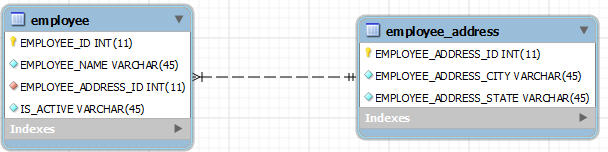
JPA supports multiple types of mapping, in this tutorial we will see how to do “Uni-Directional” One to One Mapping.
First we will setup our pom.
pom.xml
<project xmlns="http://maven.apache.org/POM/4.0.0" xmlns:xsi="http://www.w3.org/2001/XMLSchema-instance"
	xsi:schemaLocation="http://maven.apache.org/POM/4.0.0
		http://maven.apache.org/xsd/maven-4.0.0.xsd">
	<modelVersion>4.0.0</modelVersion>
	<groupId>com.mumz.test.jpa</groupId>
	<artifactId>TestJPAProject</artifactId>
	<version>0.0.1-SNAPSHOT</version>
	<name>TestJPAProject</name>
	<description>TestJPAProject</description>
	<dependencies>
		<dependency>
			<groupId>org.hibernate.javax.persistence</groupId>
			<artifactId>hibernate-jpa-2.0-api</artifactId>
			<version>1.0.0.Final</version>
		</dependency>
	</dependencies>
	<build>
		<plugins>
			<plugin>
				<artifactId>maven-compiler-plugin</artifactId>
				<configuration>
					<source>1.6</source>
					<target>1.6</target>
				</configuration>
			</plugin>
		</plugins>
	</build>
</project>
Second we will write our simple Employee entity.
Employee.java
/**
 *
 */
package com.mumz.jpa.mapping.onetoone;

import java.io.Serializable;

import javax.persistence.CascadeType;
import javax.persistence.Column;
import javax.persistence.Entity;
import javax.persistence.GeneratedValue;
import javax.persistence.GenerationType;
import javax.persistence.Id;
import javax.persistence.JoinColumn;
import javax.persistence.OneToOne;
import javax.persistence.Table;

/**
 * The Class Employee.
 *
 * @author prabhat.jha
 */
@Entity
@Table(name = "")
public class Employee implements Serializable {

	/** The Constant serialVersionUID. */
	private static final long	serialVersionUID	= 578658067302993111L;

	/** The id. */
	private Long				id					= null;

	/** The name. */
	private String				name				= null;

	/** The is active. */
	private String				isActive			= null;

	/** The address. */
	private EmployeeAddress		address				= null;

	/**
	 * Gets the id.
	 *
	 * @return the id
	 */
	@Id
	@GeneratedValue(strategy = GenerationType.AUTO)
	@Column(name = "EMPLOYEE_ID")
	public Long getId() {
		return id;
	}

	/**
	 * Sets the id.
	 *
	 * @param id
	 *            the id to set
	 */
	public void setId(Long id) {
		this.id = id;
	}

	/**
	 * Gets the name.
	 *
	 * @return the name
	 */
	@Column(name="EMPLOYEE_NAME")
	public String getName() {
		return name;
	}

	/**
	 * Sets the name.
	 *
	 * @param name
	 *            the name to set
	 */
	public void setName(String name) {
		this.name = name;
	}

	/**
	 * Gets the checks if is active.
	 *
	 * @return the isActive
	 */
	@Column(name="IS_ACTIVE")
	public String getIsActive() {
		return isActive;
	}

	/**
	 * Sets the checks if is active.
	 *
	 * @param isActive
	 *            the isActive to set
	 */
	public void setIsActive(String isActive) {
		this.isActive = isActive;
	}

	/**
	 * Gets the address.
	 *
	 * @return the address
	 */
	@OneToOne(cascade=CascadeType.ALL)
	@JoinColumn(name="EMPLOYEE_ADDRESS_ID")
	public EmployeeAddress getAddress() {
		return address;
	}

	/**
	 * Sets the address.
	 *
	 * @param address
	 *            the address to set
	 */
	public void setAddress(EmployeeAddress address) {
		this.address = address;
	}

	/**
	 * (non-Javadoc)
	 * @see java.lang.Object#hashCode()
	 */
	@Override
	public int hashCode() {
		final int prime = 31;
		int result = 1;
		result = prime * result + ((address == null) ? 0 : address.hashCode());
		result = prime * result + ((id == null) ? 0 : id.hashCode());
		result = prime * result + ((isActive == null) ? 0 : isActive.hashCode());
		result = prime * result + ((name == null) ? 0 : name.hashCode());
		return result;
	}

	/**
	 * (non-Javadoc)
	 * @see java.lang.Object#equals(java.lang.Object)
	 */
	@Override
	public boolean equals(Object obj) {
		if (this == obj) {
			return true;
		}
		if (obj == null) {
			return false;
		}
		if (!(obj instanceof Employee)) {
			return false;
		}
		Employee other = (Employee) obj;
		if (address == null) {
			if (other.address != null) {
				return false;
			}
		} else if (!address.equals(other.address)) {
			return false;
		}
		if (id == null) {
			if (other.id != null) {
				return false;
			}
		} else if (!id.equals(other.id)) {
			return false;
		}
		if (isActive == null) {
			if (other.isActive != null) {
				return false;
			}
		} else if (!isActive.equals(other.isActive)) {
			return false;
		}
		if (name == null) {
			if (other.name != null) {
				return false;
			}
		} else if (!name.equals(other.name)) {
			return false;
		}
		return true;
	}

	/** (non-Javadoc)
	 * @see java.lang.Object#toString()
	 */
	@Override
	public String toString() {
		return String.format("Employee [id=%s, name=%s, isActive=%s, address=%s]", id, name, isActive, address);
	}
}
Third we will write the second entity EmployeeAddress.
EmployeeAddress.java
package com.mumz.jpa.mapping.onetoone;

import java.io.Serializable;

import javax.persistence.Column;
import javax.persistence.Entity;
import javax.persistence.GeneratedValue;
import javax.persistence.GenerationType;
import javax.persistence.Id;
import javax.persistence.Table;

/**
 * The Class EmployeeAddress.
 *
 * @author prabhat.jha
 */
@Entity
@Table(name = "EMPLOYEE_ADDRESS")
public class EmployeeAddress implements Serializable {

	/** The Constant serialVersionUID. */
	private static final long	serialVersionUID	= -3901477366664399455L;

	/** The id. */
	private Long				id					= null;

	/** The state. */
	private String				state				= null;

	/** The city. */
	private String				city				= null;

	/**
	 * Gets the id.
	 *
	 * @return the id
	 */
	@Id
	@GeneratedValue(strategy = GenerationType.AUTO)
	@Column(name = "EMPLOYEE_ADDRESS_ID")
	public Long getId() {
		return id;
	}

	/**
	 * Sets the id.
	 *
	 * @param id
	 *            the id to set
	 */
	public void setId(Long id) {
		this.id = id;
	}

	/**
	 * Gets the state.
	 *
	 * @return the state
	 */
	@Column(name="EMPLOYEE_ADDRESS_STATE")
	public String getState() {
		return state;
	}

	/**
	 * Sets the state.
	 *
	 * @param state
	 *            the state to set
	 */
	public void setState(String state) {
		this.state = state;
	}

	/**
	 * Gets the city.
	 *
	 * @return the city
	 */
	@Column(name = "EMPLOYEE_ADDRESS_CITY")
	public String getCity() {
		return city;
	}

	/**
	 * Sets the city.
	 *
	 * @param city
	 *            the city to set
	 */
	public void setCity(String city) {
		this.city = city;
	}

	/**
	 * (non-Javadoc).
	 *
	 * @return the int
	 * @see java.lang.Object#hashCode()
	 */
	@Override
	public int hashCode() {
		final int prime = 31;
		int result = 1;
		result = prime * result + ((city == null) ? 0 : city.hashCode());
		result = prime * result + ((id == null) ? 0 : id.hashCode());
		result = prime * result + ((getState() == null) ? 0 : getState().hashCode());
		return result;
	}

	/**
	 * (non-Javadoc).
	 *
	 * @param obj
	 *            the obj
	 * @return true, if successful
	 * @see java.lang.Object#equals(java.lang.Object)
	 */
	@Override
	public boolean equals(Object obj) {
		if (this == obj) {
			return true;
		}
		if (obj == null) {
			return false;
		}
		if (!(obj instanceof EmployeeAddress)) {
			return false;
		}
		EmployeeAddress other = (EmployeeAddress) obj;
		if (city == null) {
			if (other.city != null) {
				return false;
			}
		} else if (!city.equals(other.city)) {
			return false;
		}
		if (id == null) {
			if (other.id != null) {
				return false;
			}
		} else if (!id.equals(other.id)) {
			return false;
		}
		if (getState() == null) {
			if (other.getState() != null) {
				return false;
			}
		} else if (!getState().equals(other.getState())) {
			return false;
		}
		return true;
	}

	/**
	 * (non-Javadoc).
	 *
	 * @return the string
	 * @see java.lang.Object#toString()
	 */
	@Override
	public String toString() {
		return String.format("EmployeeAddress [id=%s, state=%s, city=%s]", id, getState(), city);
	}
}
Third we need persistence.xml, create persistence.xml inside your META-INF folder under src/main/resources.
persistence.xml
<?xml version="1.0" encoding="UTF-8"?>
<persistence version="2.0"
	xmlns="http://java.sun.com/xml/ns/persistence"
	xmlns:xsi="http://www.w3.org/2001/XMLSchema-instance"
	xsi:schemaLocation=
		"http://java.sun.com/xml/ns/persistence
		http://java.sun.com/xml/ns/persistence/persistence_2_0.xsd">

	<persistence-unit name="jpaPersistenceUnit"
		transaction-type="RESOURCE_LOCAL">
		<class>com.mumz.jpa.mapping.onetoone.Employee</class>
		<class>com.mumz.jpa.mapping.onetoone.EmployeeAddress</class>
		<properties>
			<property name="javax.persistence.jdbc.driver" value="com.mysql.jdbc.Driver" />
			<property name="javax.persistence.jdbc.url" value="jdbc:mysql://localhost:3306/jpa_schema" />
			<property name="javax.persistence.jdbc.user" value="root" />
			<property name="javax.persistence.jdbc.password" value="root" />
		</properties>
	</persistence-unit>
</persistence>
Fourth we need the schema of the database, in this tutorial we are using MySQL.
jpa_schema
SET @OLD_UNIQUE_CHECKS=@@UNIQUE_CHECKS, UNIQUE_CHECKS=0;
SET @OLD_FOREIGN_KEY_CHECKS=@@FOREIGN_KEY_CHECKS, FOREIGN_KEY_CHECKS=0;
SET @OLD_SQL_MODE=@@SQL_MODE, SQL_MODE='TRADITIONAL';

DROP SCHEMA IF EXISTS `jpa_schema` ;
CREATE SCHEMA IF NOT EXISTS `jpa_schema` DEFAULT CHARACTER SET utf8 ;
USE `jpa_schema` ;

-- -----------------------------------------------------
-- Table `jpa_schema`.`employee_address`
-- -----------------------------------------------------
DROP TABLE IF EXISTS `jpa_schema`.`employee_address` ;

CREATE  TABLE IF NOT EXISTS `jpa_schema`.`employee_address` (
  `EMPLOYEE_ADDRESS_ID` INT(11) NOT NULL AUTO_INCREMENT ,
  `EMPLOYEE_ADDRESS_CITY` VARCHAR(45) NOT NULL ,
  `EMPLOYEE_ADDRESS_STATE` VARCHAR(45) NOT NULL ,
  PRIMARY KEY (`EMPLOYEE_ADDRESS_ID`) )
ENGINE = InnoDB
AUTO_INCREMENT = 7
DEFAULT CHARACTER SET = utf8;

-- -----------------------------------------------------
-- Table `jpa_schema`.`employee`
-- -----------------------------------------------------
DROP TABLE IF EXISTS `jpa_schema`.`employee` ;

CREATE  TABLE IF NOT EXISTS `jpa_schema`.`employee` (
  `EMPLOYEE_ID` INT(11) NOT NULL AUTO_INCREMENT ,
  `EMPLOYEE_NAME` VARCHAR(45) NOT NULL ,
  `EMPLOYEE_ADDRESS_ID` INT(11) NOT NULL ,
  `IS_ACTIVE` VARCHAR(45) NOT NULL ,
  PRIMARY KEY (`EMPLOYEE_ID`) ,
  INDEX `FK_EMPLOYEE_ADDRESS_ID` (`EMPLOYEE_ADDRESS_ID` ASC) ,
  CONSTRAINT `FK_EMPLOYEE_ADDRESS_ID`
    FOREIGN KEY (`EMPLOYEE_ADDRESS_ID` )
    REFERENCES `jpa_schema`.`employee_address` (`EMPLOYEE_ADDRESS_ID` )
    ON DELETE NO ACTION
    ON UPDATE NO ACTION)
ENGINE = InnoDB
AUTO_INCREMENT = 7
DEFAULT CHARACTER SET = utf8;

SET SQL_MODE=@OLD_SQL_MODE;
SET FOREIGN_KEY_CHECKS=@OLD_FOREIGN_KEY_CHECKS;
SET UNIQUE_CHECKS=@OLD_UNIQUE_CHECKS;
Final step is write some test code to check if our code is working, Let’s write a simple Java program which will do this for us.
OneToOneUniDirectionalMainApp.java
package com.mumz.jpa.mapping.onetoone;

import javax.persistence.EntityManager;
import javax.persistence.EntityTransaction;
import javax.persistence.Persistence;

public class OneToOneUniDirectionalMainApp {

	public static void main(String[] args) {
		EntityManager entityManager = Persistence.createEntityManagerFactory("jpaPersistenceUnit").createEntityManager();

		Employee employee = new Employee();
		employee.setIsActive("True");
		employee.setName("Test");

		EmployeeAddress employeeAddress = new EmployeeAddress();
		employeeAddress.setCity("XYZ");
		employeeAddress.setState("ABC");
		employee.setAddress(employeeAddress);

		EntityTransaction transaction = entityManager.getTransaction();
		try {
			transaction.begin();
			entityManager.persist(employee);
			transaction.commit();
			employee = entityManager.find(Employee.class, new Long(2));
			System.out.println(employee);
		} catch (Exception e) {
			e.printStackTrace();
			transaction.rollback();
		} finally {
			entityManager.close();
		}
	}
}
Yeah we are all done!
 Code Holic

Cool dude 🙂
Way to go